
As pediatricians, we often say that children are not just “small adults.” Their presentations can surprise us, puzzle us, and at times humble us.
Recently, I came across a case that has stayed with me — not just because of the diagnosis, but because of how it unfolded, how easily it was missed, and the lessons it left behind and how his parents cried in front of me, begging to save his life, but I could do nothing, literally nothing at all.
The story is about a healthy 7-year-old boy from Gulmi, Nepal. He was like any other child who was immunized and doing good in sports and studies. He loved playing taekwondo and occasional sports, was a big-time football league fan, and had no prior health concerns.
Then the symptoms began.
It All Started with Neck Pain
He started complaining of neck pain for about one month. Neck pain was gradually worsening; however, it would get relieved with painkillers. He was taken to multiple doctors before he came to his center and was labelled as having spasmodic neck pain and treated with some muscle relaxants.
He also developed constipation, for which he was being managed with laxatives. To be honest, my thesis is on constipation, and this made me think that constipation should never be taken lightly; sometimes this could be an uncommon symptom of some lethal disease.
But his symptoms didn’t improve. Over time he started to develop frequent headaches, and parents also noticed that his balance wasn’t right when he was walking.
By the time he reached our emergency room, he had had a severe headache for three days and worsening neck pain, with intractable vomiting.
In the Emergency Room
On examination, he was fully conscious, and his vitals were stable. But his neurological exam told another story.
He had:
- Cerebellar signs: ataxic gait, past pointing, failed tandem walk.
- Meningeal signs: neck stiffness, positive Kernig’s and Brudzinski’s.
- Motor findings: exaggerated lower limb reflexes.
We suspected this was a case of raised intracranial pressure, and immediately the eyes were looked for papilledema, and it showed there were signs of papilledema, so we started on its management of raised ICP with standard protocol.
An MRI was done, and then it revealed what we had started to suspect: a posterior fossa tumor with metastasis in the spine.
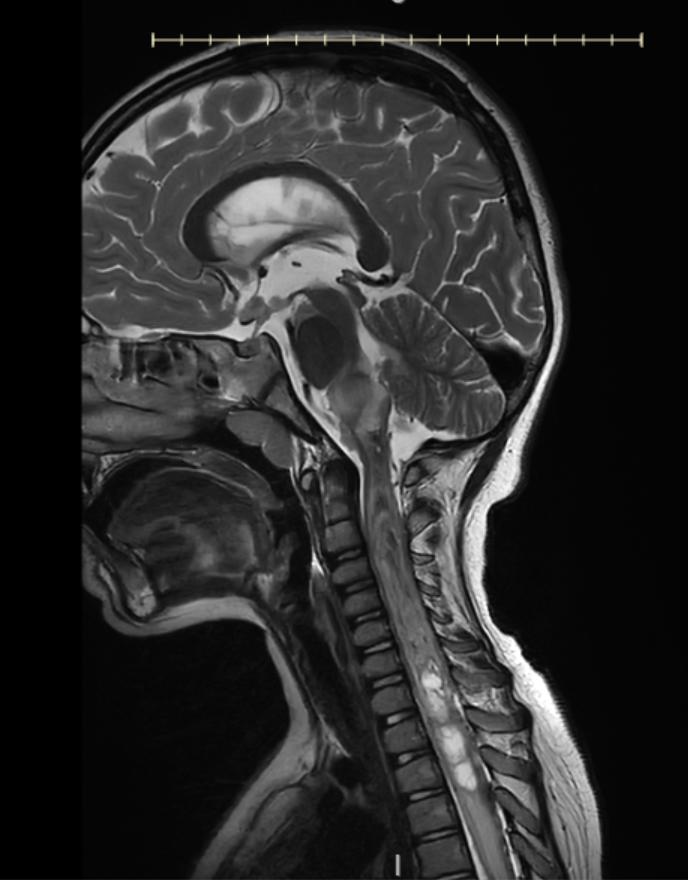
Sadly, by the next day, there was complete loss of power below his neck, and by evening, the child had difficulty in holding his neck and also producing voice or swallowing, signs of bulbar palsy, a worrisome sign that he might not be able to protect his airway,
And then came the difficult task.
I talked with his mother about how the child needs to be kept on a mechanical ventilator because the child seems to have difficulty speaking and swallowing, and if we don’t do that, there is a chance that the child could lose his ability to breathe at any moment.
But deep inside I had this feeling the child maybe never have the chance to be out of the ventilator if is intubated, but I couldn’t say this to her, maybe my knowledge were not enough or maybe I still had a trust that some miracle might happen, as I have already seen many miracles in this short career so far, and she called his father to sign the consent.
I told the father things that I had earlier communicated with his mother, and maybe he understood that it would be his last time that he could see his son talking with him, and then
he cried, and .. cried,
when a man cries it burns our heart, like those stab to heart with an old rusty knife, he folded his hands with words — please save my son, we have nothing else in our life, I was speechless, I couldn’t utter a word, I hugged him with my watery eyes with some broken comforting words that came out of mind.
I requested him to sign the consent form to keep him on the ventilator, and then we went on to prepare him for intubation. That day, my hands trembled as I held the ET tube. The nurses asked why I seemed anxious, but I had no words to reply…
3 days later, the little boy passed away, surrounded by his loved ones.
Lessons that stay with us:
Oddities matter: Constipation and neck pain are common complaints if they occur separately, but if they occur together, we need to worry. Common symptoms, if present, are uncommon; we need to worry.
Children compensate until they suddenly can’t: I have seen this often; children come with very short histories, but on digging further, it feels the illness was a long time ago; it’s just the body was so good at compensating.
Not all diseases give us a second chance: Some conditions close the window of opportunity forever.
Originally posted on medium: When an “Interesting Case” Becomes a Lifelong Lesson | by Vivek Karn | Medium