
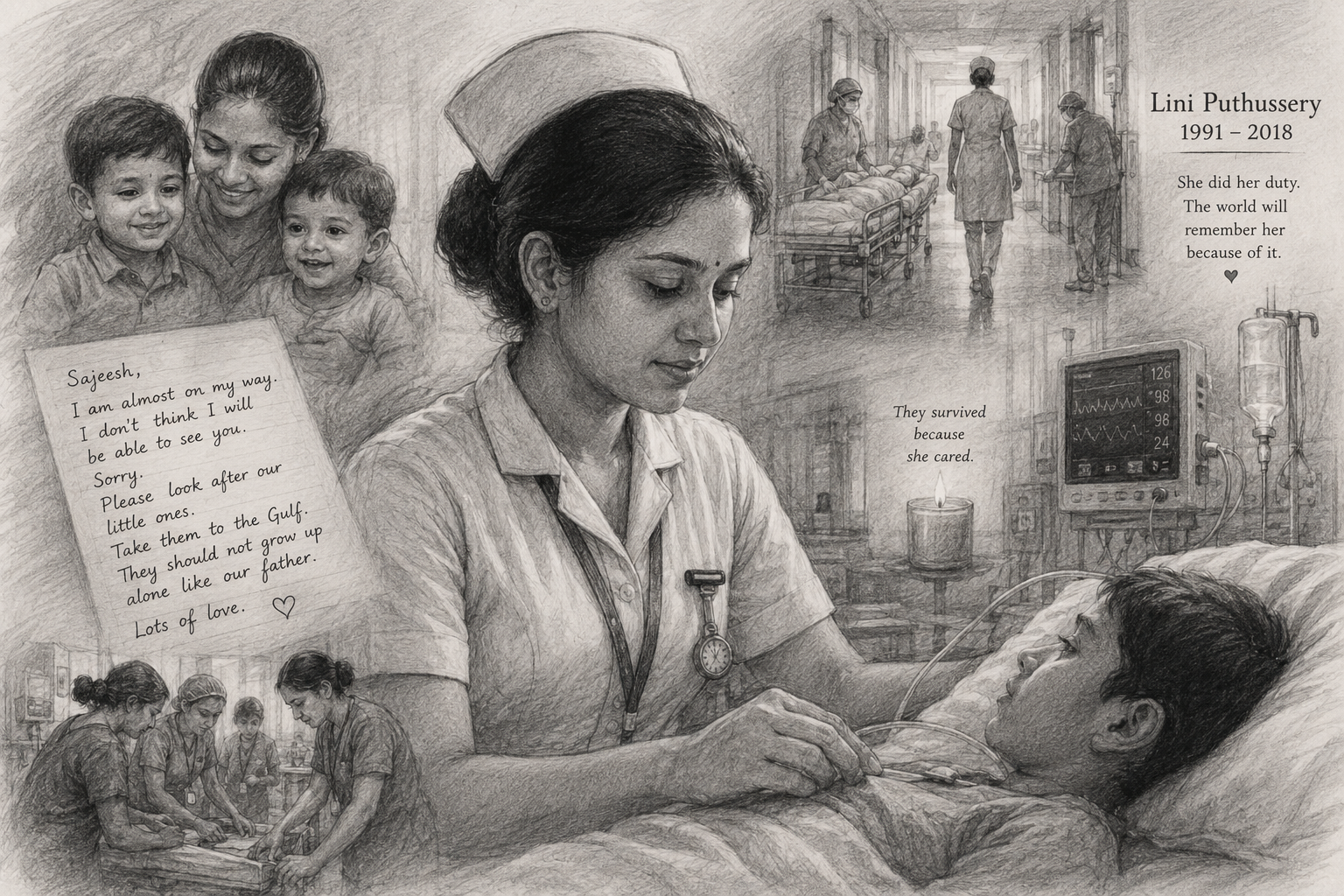
On this Nurse day, I remember a movie, that I had watched maybe during my internship period.
After watching the movie, late at night, I ended up reading about the real story of Lini Puthussery and the 2018 Nipah outbreak in Kerala. And somehow, it hit even harder.
Maybe because I work in pediatrics. Maybe because once you spend enough nights inside a hospital, you begin to understand who quietly carries the weight of the entire system.
Lini was not a celebrity, not a politician, not someone the world was supposed to remember. She was a nurse. At 31, she worked at the Perambra Taluk Hospital in Kerala, six years of shifts behind her, and at home, two little boys who waited for her every day. Ritul was five. Siddharth was only two.
In May 2018, something terrifying entered Kerala. Patients began arriving with a strange illness, fever and confusion and rapid deterioration, and nobody fully understood what they were facing. One night, three critically ill members of the same family were brought in. Lini was on duty. She did what nurses do. She stayed, monitored them, comforted them, treated them through the night before anyone fully realized how deadly the virus was.
Soon after, the patients died. Tests confirmed Nipah.
Days later, Lini herself developed fever. She was shifted to the ICU at Kozhikode Medical College, and by then she already understood what it meant. Nipah had very few survivors. Even from isolation, her first thoughts were about protecting others. She asked the hospital not to let her sisters visit.
Then she wrote a final note to her husband.
“Sajeesh, I am almost on my way. I don’t think I will be able to see you. Sorry. Please look after our little ones. Take them to the Gulf. They should not grow up alone like our father. Lots of love.”
On May 21, 2018, Lini Puthussery died. Her body was cremated quickly under infection control protocols, and her family barely had time to grieve beside her.
She never asked whether the patient was dangerous. She never stepped back because she was a mother. She simply showed up for her shift and did her duty, and that is exactly why her story hurts so much. Because anyone who has truly worked inside a hospital has seen versions of Lini everywhere.
I have seen nurses in pediatric wards skip meals because a child suddenly deteriorated. I have seen them stay calm while parents fell apart beside the bed, emotionally emptied and physically drained, sometimes shouted at unfairly, and still walking into the next room with softness in their voice. Some nights are unbearably heavy. A sick child in the PICU, a child struggling on oxygen, a mother crying quietly near the bedside, ventilators and the monitors alarming every few minutes, and somehow nurses keep going. Not dramatically, not for praise, but with a kind of quiet consistency most people never notice and most hospitals could not survive without.
In pediatrics especially, children remember kindness before they remember medicine. Healing often begins with the nurse who made them smile during an IV line, who sat beside them when they were scared, who noticed they looked not quite right before anyone else did, who treated them like her own child for one difficult night.
Anyone who has truly worked inside a hospital knows that the building would fall apart without nurses. There is something deeply sacred about people who continue caring for others even when they are exhausted, frightened, and heartbroken themselves, who give their last written words not as a goodbye but as instructions for how the love should continue after them.
To every nurse working tonight in crowded wards, emergency rooms, NICUs, PICUs, labor rooms, and pediatric centers: many children are smiling today because of you, and many parents survived their worst nights because of you. Lini never got to go home to Ritul and Siddharth. But somewhere, because of people like her, other children got to keep their mothers
Source:Lini Puthussery: India’s ‘hero’ nurse who died battling Nipah virus
No spam. Just a short email when I publish something new.