
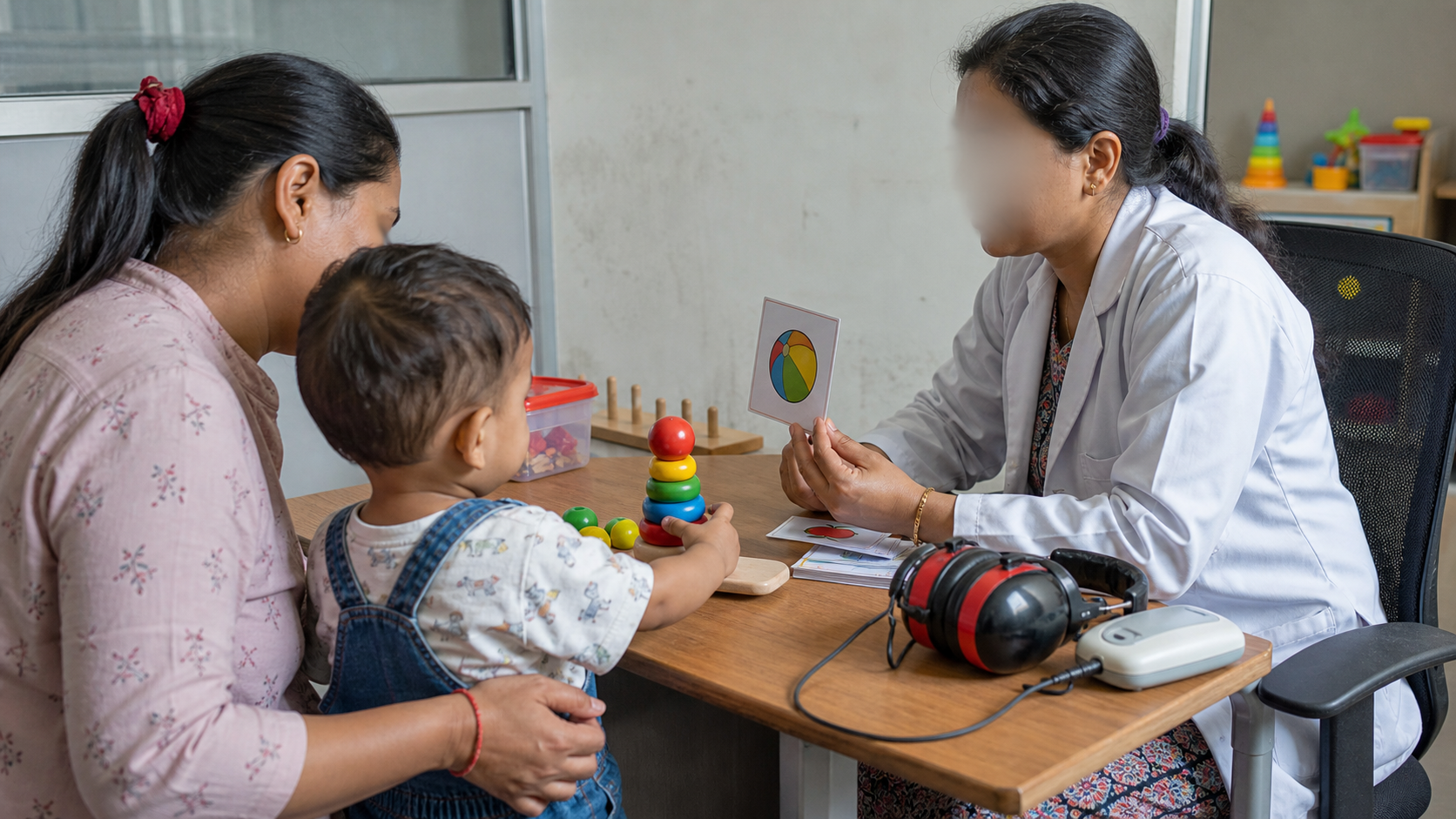
“My child is 2 years old and still not speaking properly. Should I wait?”
This is one of the most anxiety-producing questions for parents. Some children are simply late talkers, but waiting blindly can delay help for hearing loss, autism spectrum disorder, developmental delay, or other problems.
In clinic, the most useful first step is not to argue about labels. It is to check hearing, communication, eye contact, play, response to name, and whether development is moving forward.
What Should a 2-Year-Old Usually Do?
Development varies, but by around 2 years many children can say several words, use simple two-word phrases, point to things, follow simple instructions, and communicate needs in some way. The exact language may be Nepali, Maithili, Hindi, English or a mix. The issue is not which language. The issue is whether communication is progressing.
First Question: Can the Child Hear?
Hearing loss is one of the most important things to rule out. A child may hear loud sounds but still have hearing difficulty that affects speech. Recurrent ear infections, delayed response to name, very loud TV volume, or no reaction to everyday sounds should raise concern.
A proper hearing assessment is often needed. Do not assume hearing is normal only because the child sometimes reacts to noise.
When to Think About Autism
Speech delay alone does not equal autism. But autism should be considered if speech delay comes with social communication concerns.
- Does not respond to name consistently
- Poor eye contact
- Does not point to show interest
- Does not bring objects to share attention
- Prefers repetitive play or lining up objects
- Strong resistance to change
- Unusual sensory reactions to sound, texture or lights
- Loss of previously acquired words or social skills
Screen Time Can Make Things Worse
Excessive screen time can reduce real interaction, imitation, turn-taking and language practice. A phone cannot replace a caregiver talking, responding, singing, reading, playing and naming the world with the child.
Screen time may not be the only cause, but reducing it is often one of the first practical steps.
What Parents Can Do Now
- Talk to the child during daily activities.
- Name objects, actions and feelings.
- Read picture books, even simple ones.
- Give choices: “milk or water?”
- Wait for the child to respond instead of anticipating everything.
- Reduce passive screen time.
- Arrange hearing evaluation and developmental assessment if delay is significant.
Do Not Wait If These Are Present
- No meaningful words by 18-24 months
- No response to name
- Loss of speech or social skills
- No pointing or shared attention
- Concerns about hearing
- Developmental delay in other areas
Early help matters. Speech therapy, parent coaching, hearing treatment, developmental intervention and autism support work best when started early. Waiting until school age can make the gap much harder to close.
What About Bilingual Homes?
Children in Nepal may hear Nepali, Maithili, Hindi, English, Bhojpuri, Newari or other languages at home. Bilingual exposure does not usually cause severe language delay by itself. A child may mix languages, but communication should still progress.
What the First Evaluation May Include
- Hearing assessment
- Developmental history
- Screening for autism features
- Assessment of social interaction and play
- Review of pregnancy, birth and neonatal history
- Speech and language therapy referral when needed
A Practical Home Plan for 4 Weeks
- Remove background TV and reduce phone use.
- Spend 15-20 minutes twice daily in face-to-face play.
- Use short repeated words during routines: eat, come, give, open, more, water.
- Praise attempts to communicate, not only perfect words.
- Do not force repeated testing: “say this, say that” all day.
If there are red flags, do not wait 4 weeks before evaluation. Start assessment and home interaction together.
Speech Delay vs Language Delay
Speech is about producing sounds and words. Language is about understanding and using communication. A child may understand well but speak late, or may have difficulty both understanding and speaking. This distinction matters because management differs.
Parents often count words, but doctors also look at gestures, pointing, response to name, pretend play, ability to follow commands, eye contact, imitation and social interest.
What “Wait and Watch” Gets Wrong
Some children do catch up. But waiting without assessment is risky. Hearing loss, autism, global developmental delay and environmental deprivation all benefit from early recognition. A child losing one year of language stimulation during the most plastic period of development is not a small thing.
Questions I Would Ask in Clinic
- Did the child ever speak words and then lose them?
- Does the child respond to name?
- Does the child point to request and point to show interest?
- Can the child follow simple commands without gesture?
- How much screen time does the child get?
- Any history of NICU stay, meningitis, recurrent ear discharge or seizures?
- Does the child play pretend games?
- How does the child communicate needs now?
Autism Is Not Diagnosed From One Symptom
Parents often fear autism as soon as speech is delayed. Autism is about social communication and restricted/repetitive patterns, not just late speech. A child with hearing loss may also not respond to name. A child with isolated expressive delay may have good eye contact and social play. That is why evaluation matters.
Practical Parent Coaching
Language grows through interaction. Sit face-to-face. Follow the child’s interest. Use short phrases. Pause. Let the child request. Expand what they say. If the child says “car,” say “red car” or “car go.” Do not turn every interaction into an exam.
If red flags are present, parent coaching should happen alongside professional assessment, not instead of it.
Developmental Red Flags Table
| Concern | Possible meaning | Next step |
|---|---|---|
| No response to name | Hearing issue, autism, attention/social communication concern. | Hearing test + developmental assessment. |
| No pointing to show interest | Social communication delay. | Autism screening and early intervention. |
| Lost words | Regression is a red flag. | Do not wait; evaluate urgently. |
| Only screen words, poor interaction | Reduced social language practice. | Reduce screen, increase face-to-face play, assess if persistent. |
Recent Advances and Availability
Developed settings increasingly use standardized autism screening, audiology, speech-language therapy, parent-mediated intervention and early developmental programs. In Nepal, access to developmental pediatricians, audiology and speech therapy is uneven and city-centered. That makes early recognition by pediatricians, parents and preschool teachers even more important.
Data/News Context
Globally, autism awareness and diagnosis have increased, but late diagnosis remains common in low-resource settings. Nepal still needs better early intervention pathways, more speech therapists, affordable hearing evaluation and less stigma around developmental assessment.
Sources and Useful Links
Sources and Further Reading
- CDC: 2-year developmental milestones
- CDC: Autism signs and symptoms
- HealthyChildren.org: Language delay
What Not to Say to Parents
“Boys talk late” is one of the most harmful reassurances when used carelessly. Some boys do talk later, but that does not mean every speech delay should be ignored. “He will speak when he goes to school” can also delay early intervention.
A better answer is: let us check hearing, development, social communication and environment. If everything looks reassuring, we can monitor with a plan. If not, we start help early.
Availability of Assessment and Therapy in Nepal
| Service | Nepal reality | Why it matters |
|---|---|---|
| Hearing test | Available in larger centers, but not always easy outside cities. | Hearing loss is a treatable cause of speech delay. |
| Speech therapy | Growing but still city-centered and costly for many families. | Early therapy improves communication and parent strategies. |
| Developmental pediatric assessment | Limited availability. | Needed when autism, global delay or regression is suspected. |
| Early intervention | Fragmented; often private or NGO-linked. | The earlier support begins, the better the chance to reduce developmental gaps. |
Recent Advances
The biggest advance is not one medicine. It is earlier identification and parent-mediated intervention. Around the world, autism and speech delay care is moving toward coaching parents to build communication during daily routines, not only sending the child to a therapist once a week.
One-Month Parent Action Plan
- Book hearing evaluation if speech delay is significant.
- Reduce passive screen time sharply.
- Give 30-60 minutes daily of divided face-to-face play.
- Use short repeated language during routines.
- Track new words, gestures and response to name.
- Seek developmental assessment immediately if there is regression, no pointing, poor eye contact or no response to name.
What a Pediatrician Looks For in the Room
Assessment starts before formal testing. Does the child look back when the parent points? Does the child bring a toy to show, or only to request help? Does the child imitate? Does the child respond to name when distracted? Does the child use gestures? How does the parent communicate with the child?
These observations help separate isolated speech delay from broader social communication delay.
When Speech Delay Is Part of Global Delay
If the child is also late in walking, fine motor skills, play, understanding, feeding skills or social interaction, the issue may not be isolated speech delay. That child needs broader developmental evaluation. Speech therapy alone may not be enough.
What Improvement Should Look Like
After reducing screen time and increasing interaction, parents should look for more than new words. Improvement may first appear as better eye contact, more pointing, more imitation, more response to name, more attempts to communicate, better shared play, or following simple commands.
If none of these improve, or if red flags are present from the beginning, do not wait for months. Early intervention does not harm a child who later turns out to be only a late talker, but delayed intervention can harm a child who needed help.
What To Tell Grandparents and Family
Many Nepali families hear advice like “boys speak late” or “father also spoke late.” Family history can be relevant, but it should not replace assessment. A useful family message is: we are not labeling the child; we are checking hearing, communication and development early so we do not lose time.
No spam. Just a short email when I publish something new.