
Updated: May 2026
Glycolysis is one of those topics that looks simple until it starts connecting to diabetes, hypoxia, hemolysis, sepsis, cancer metabolism, lactic acidosis and inherited enzyme defects.
Glycolysis in One Line
Glycolysis is the pathway that breaks one glucose molecule into two pyruvate molecules, producing a small amount of ATP and NADH in the process.
The Three Things to Remember
- It happens in the cytoplasm.
- It does not require oxygen directly.
- It produces ATP quickly, but not efficiently.
The Pathway: High-Yield Version
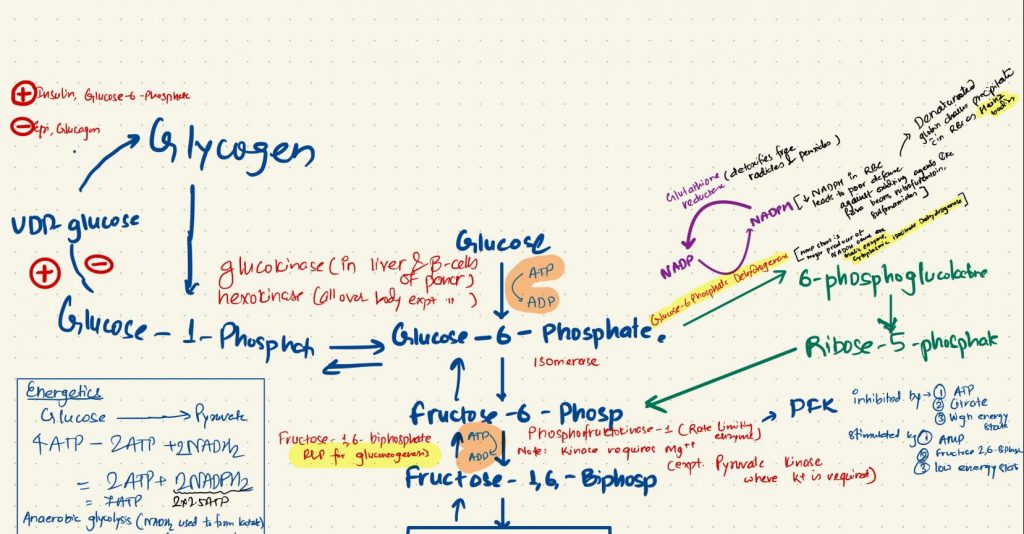
- Glucose to glucose-6-phosphate by hexokinase/glucokinase. This traps glucose inside the cell.
- Fructose-6-phosphate to fructose-1,6-bisphosphate by phosphofructokinase-1. This is the key committed step.
- Glyceraldehyde-3-phosphate onward produces NADH and ATP.
- Phosphoenolpyruvate to pyruvate by pyruvate kinase. This produces ATP.
Rate-Limiting Step
The most important regulatory enzyme is PFK-1.
- Activated by: AMP and fructose-2,6-bisphosphate
- Inhibited by: ATP and citrate
In simple words: when the cell is low on energy, glycolysis speeds up. When the cell has enough energy, glycolysis slows down.
Net Yield
From one glucose molecule:
- 2 ATP net
- 2 NADH
- 2 pyruvate
What Happens to Pyruvate?
- With oxygen: pyruvate enters mitochondria and becomes acetyl-CoA for the TCA cycle.
- Without enough oxygen: pyruvate becomes lactate.
This is why lactate rises in shock, severe hypoxia, seizures and other high-stress states.
Clinical Links
- Red blood cells depend on glycolysis because they do not have mitochondria.
- Pyruvate kinase deficiency can cause hemolytic anemia.
- Hypoxia increases lactate because pyruvate is pushed toward lactate.
- Cancer cells often use glycolysis heavily even when oxygen is present. This is the Warburg effect.
- Fructose-2,6-bisphosphate is an important insulin/glucagon-linked regulator of glycolysis and gluconeogenesis.
Exam Memory
The irreversible enzymes are:
- Hexokinase/glucokinase
- PFK-1
- Pyruvate kinase
If you remember only one enzyme, remember PFK-1.
No spam. Just a short email when I publish something new.