Updated: May 30, 2026
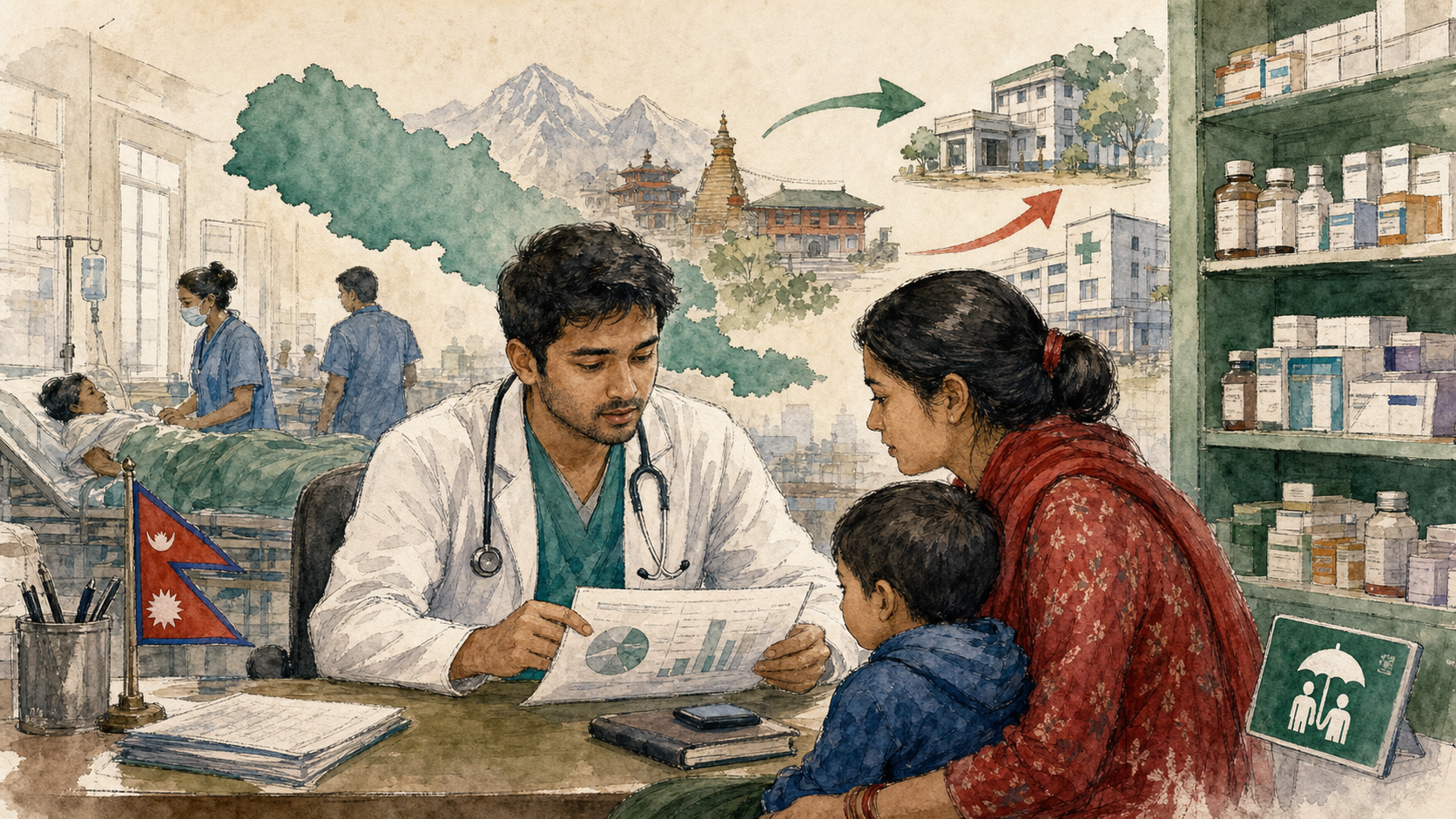
I read the official budget speech for FY 2083/84, presented on May 29, 2026 / 2083 Jestha 15. The health section is more interesting than the headline number. It is not only saying “we gave health some money.” It is trying to redesign how a patient should enter the health system: through basic institutions with staff, labs, medicines, digital records and referral links.
That is the useful way to read this budget. The promise is not Rs 101.95 billion. The promise is whether a sick child, an old man with COPD, a mother in labor, or a cancer patient can reach a functioning service without being destroyed financially.
My short read: the budget has good direction, especially on insurance reform, free pediatric cancer treatment, basic hospital completion, essential medicines and remote care. But it also has the usual Nepali risk: buildings, cards and announcements may arrive faster than staff, medicines, claim payments and accountability.
1. The Headline: Rs 101.95 Billion for Health
The budget allocates Rs 101.95 billion to the health sector. Against the total national budget of about Rs 2.124 trillion, that is roughly 4.8% of the total budget.
So the first reality check is simple: this is not an enormous health budget. It has to cover insurance, social protection, basic hospitals, medicines, infrastructure, digital systems, salaries and service delivery.
- Total health-sector allocation: Rs 101.95 billion.
- Health insurance program: Rs 15 billion.
- Poor-citizen treatment, safe motherhood, free medicines and health social-security programs: Rs 13.15 billion.
- Basic hospital operation and infrastructure: Rs 5.90 billion.
2. The Real Promise: Primary Care That Actually Functions
One paragraph in the budget is easy to miss, but it is the most important one. The speech says basic health institutions should become the first point of health care, supported by skilled health workers, laboratories, essential medicines, digital health systems and effective referral services.
That is exactly the right list. In Nepal, the patient pathway often breaks before the patient reaches a specialist. A health post may not have the test. A basic hospital may not have the medicine. A district hospital may not have oxygen, blood, an ultrasound, or a working referral plan. Families then move from place to place, spending money at every stop.
If the budget really strengthens that first point of care, it will matter more than many large hospital announcements. But this is also the hardest promise to verify because it is not one building or one machine. It is a system.
3. Health Insurance: The Big Reform, But Also the Big Risk
The budget says the health insurance program will be widely restructured. It talks about integrating scattered social health-security programs and health liabilities into a single payment system. It also sets a political target: 90% of Nepalis under health insurance within three years.
That sounds ambitious. But the expected-results annex gives a more grounded one-year target: health-insurance coverage from 37% to 45% by the end of 2083/84. I actually like seeing that number because it tells us the three-year target will not happen by slogan. It needs yearly implementation.
What will decide whether insurance works
- Hospitals must be paid on time. If claim reimbursement is delayed, hospitals quietly stop prioritizing insured patients.
- The package must match real disease burden, not only a list on paper.
- Medicines and investigations must be available where patients are treated.
- Poor and elderly patients need help navigating the system, not just enrollment.
- Private, community and government hospitals need clear rules and accountability.
Insurance can reduce out-of-pocket spending. But only if it works at the counter, in the pharmacy, in the lab and in the ward. A card that does not buy service is just plastic.
4. The Expected Results Annex Is More Honest Than the Speech
Budget speeches are designed to sound confident. The expected-results annex is more useful because it gives measurable targets. These are the numbers I would watch next year:
- Health-insurance enrollment: 37% to 45%.
- Out-of-pocket share of total health spending: 58% to 56%.
- Households within 30 minutes of a health institution: 75% to 80%.
- Full immunization among children: 86% to 88%.
- Institutional delivery: 77% to 85%.
- Neonatal mortality: 21 to 20 per 1,000 live births.
- Under-five mortality: 25 to 24 per 1,000.
These targets make the budget feel less magical and more real. They show a health system trying to move, but not expecting miracles in one year.
5. 336 Basic Hospitals: Finish What Was Started
The budget says 336 basic hospitals already under construction will be completed within three years. For hospitals not yet started, construction will proceed only after scientific mapping.
This is a good correction. Nepal has a habit of announcing buildings before deciding whether there are enough doctors, nurses, lab staff, medicines, electricity, oxygen, roads and patients to justify them. Completing what has already started is better than announcing another layer of half-built hospitals.
But a basic hospital is not successful when the ribbon is cut. It is successful when fever, pneumonia, delivery complications, dehydration, newborn illness, injuries, asthma, seizures and poisoning can be stabilized safely before referral.
6. Free Cancer Treatment for Children Is the Most Important Pediatric Promise
The line that matters most to me as a pediatrics resident is this: children with cancer will receive free treatment in government hospitals.
This is a strong announcement. Childhood cancer is not only a medical diagnosis. It is a financial shock. Families borrow, sell land, move cities, stop working, and still struggle with the cost of investigations, chemotherapy, antibiotics, blood products, ICU care and travel.
But free pediatric cancer care cannot mean only free chemotherapy. A child with leukemia needs diagnostics, transfusion support, infection care, nutrition, central-line care, ICU backup, long follow-up and family support. If those parts are not covered, the word “free” will become smaller in real life than it sounds in the speech.
7. Medicines and Regulation: Quietly One of the Most Practical Sections
The budget says Nepal Aushadhi Limited will be strengthened to produce at least 25 types of free essential medicines. It also says a new Food and Drug Administration will be established to regulate medicines, diagnostic products, health-related goods and food quality.
“Sulav Pharmacy” is planned in all health institutions through community, cooperative and private-sector partnership, and the National Drug Laboratory is to be upgraded.
This section is less flashy than hospital buildings, but it may matter more to ordinary patients. A prescription is useless if the medicine is unavailable, expensive, poor quality or different every time the patient returns.
The Food and Drug Administration idea is also important, but only if it has teeth: laboratory capacity, inspections, pharmacovigilance, action against substandard medicines, and independence from pressure. Otherwise it becomes another board with a new name.
8. Digital Health: Useful, But Privacy Cannot Be an Afterthought
The budget promises One Citizen, One Digital Profile for real-time monitoring in all health institutions. If done well, this could solve a real problem. Patients should not have to carry half-torn reports in plastic folders forever. A child with chronic illness should not lose history every time the family changes hospital.
But digital health can also fail badly. Nepal needs clear answers: who owns the data, who can see it, how consent works, whether public and private systems can talk to each other, and what happens when internet or electricity fails.
Digital health should reduce friction. It should not become another slow counter before seeing the doctor.
9. Madhesh, Karnali and Remote Care: Good Geography, Hard Execution
The budget mentions infrastructure work for Narayani Hospital, Gajendra Narayan Singh Hospital and Ramraja Prasad Singh Academy of Health Sciences. Madhesh Province is to get a kidney disease treatment center and a trauma center.
For Karnali and Sudurpaschim, the budget talks about telemedicine, video consultations and specialist services in remote areas. It also says air ambulance service will start in remote parts of Karnali.
These are good priorities. But remote medicine is not solved by video alone. Someone local must examine the patient, check vitals, give initial treatment, arrange oxygen, communicate clearly, and refer when needed. Air ambulance also needs protocols: who qualifies, who pays, who coordinates, where the patient lands, and what happens after landing.
10. Health Workers: The Budget Notices Nurses and FCHVs
The budget doubles night-duty allowance for nursing staff and increases transport support for female community health volunteers by 50%.
This will not solve staffing shortage, burnout, workplace violence, low pay or migration. But it is still worth noting because nurses and FCHVs carry a large part of Nepal’s health system. Hospitals are not run by equipment. They are run by people who are awake at 2 AM.
The budget also says quotas in medical, nursing and IT higher education will be reviewed and significantly increased within the current fiscal year. That could help long-term workforce supply, but only if training quality and deployment are protected. More seats without clinical training quality will create another problem.
11. What I Like in This Budget
- It frames basic health institutions as the first point of care, not just as small buildings.
- It admits health insurance needs restructuring.
- It gives a concrete pediatric promise through free cancer treatment for children.
- It links medicines, pharmacy, drug regulation and laboratory upgrading.
- It includes remote health, telemedicine, high-altitude sickness, burn care and epidemic response.
- It gives measurable targets in the annex, including immunization, insurance and out-of-pocket spending.
12. What Still Worries Me
- Rs 101.95 billion is not much if the goal is system transformation.
- Insurance expansion can become enrollment without service if claim payments and hospital participation are weak.
- Basic hospitals may be completed physically but remain clinically underpowered.
- Free child cancer care may sound bigger than the actual package unless investigations, blood, antibiotics, ICU and follow-up are included.
- Digital health may be rolled out before privacy, interoperability and downtime plans are ready.
- Remote telemedicine may become symbolic unless referral transport and local capacity improve.
My Bottom Line
This is not a useless health budget. It has some of the right ideas. But it is also not a budget that should be celebrated from the speech alone. The real story will be visible in hospitals.
If insurance claims are paid, medicines are available, basic hospitals function, children with cancer actually get comprehensive free care, and digital records make treatment easier, this budget will matter.
If not, it will become what many health budgets become in Nepal: good words, scattered buildings, exhausted staff and patients still paying from their own pockets.
Source
No spam. Just a short email when I publish something new.