
Updated: May 2026
Most fever, pain, and weight loss in children are not cancer. But the few that are cancer are often missed because the early symptoms look ordinary.
Short answer: Childhood cancer is uncommon, but persistent fever, bone pain, unexplained weight loss, swelling, pallor, bruising, repeated infections, or neurological symptoms should not be ignored. Early diagnosis can change survival.
Why This Matters in Nepal
In a busy OPD, fever is common, leg pain is common, and poor appetite is common. That is exactly why childhood cancer can be missed. The first symptoms often look like infection, rheumatologic disease, trauma, anemia, malnutrition, or “psychological” complaints.
As a pediatric resident, the cases that stay with me are not only the rare diagnoses. They are the children who moved from doctor to doctor because the story did not fit neatly at first.
Warning Signs Parents Should Not Ignore
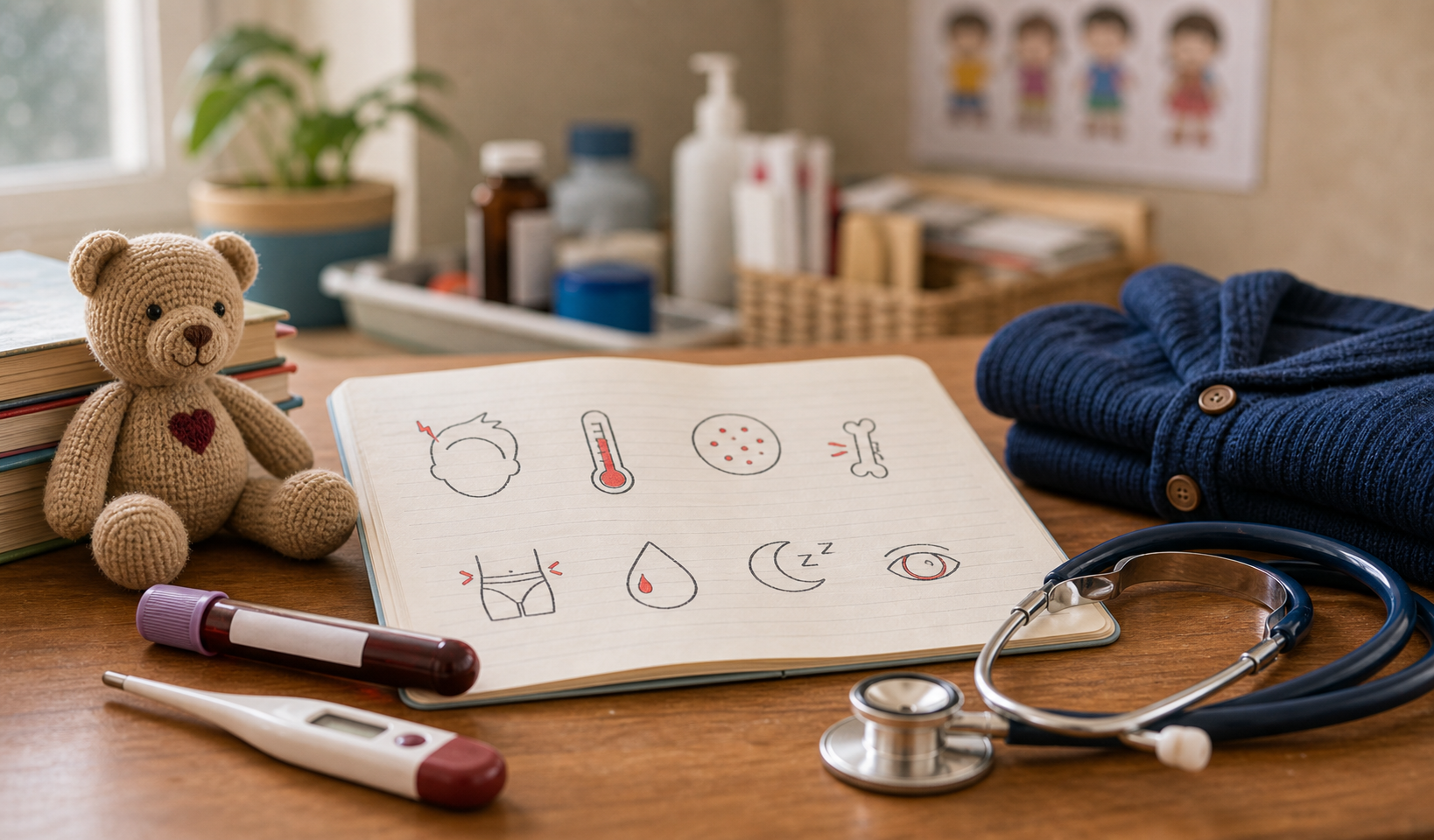
| Warning sign | Why it matters |
|---|---|
| Fever lasting more than 2 weeks without clear cause | Can be infection, TB, autoimmune disease, or malignancy |
| Persistent bone pain, especially night pain or pain limiting walking | Seen in leukemia, bone tumors, or other serious disease |
| Pallor, bruising, bleeding gums, repeated infections | Possible bone marrow involvement such as leukemia |
| Unexplained weight loss or poor growth | Needs evaluation, especially with fever or pain |
| Lump in neck, abdomen, testis, bone, or soft tissue | Persistent or enlarging swelling should be examined |
| Morning headache, repeated vomiting, balance problem, vision change | Possible raised intracranial pressure or brain tumor |
| White reflex in eye or new squint | Possible retinoblastoma or other eye disease |
Bone Pain Is Not Always Joint Pain
This is a common clinical trap. A child may say “joint pain” because that is the only language they know. But on careful history the pain may be deep, diffuse, severe at night, not related to movement, or associated with pallor and fatigue.
If a child has persistent limb pain plus falling hemoglobin, abnormal WBC, low platelets, fever, weight loss, or refusal to walk, do not stop at painkillers.
What Tests May Be Needed
The first useful test is often simple: CBC with differential and peripheral smear. Depending on the story, doctors may add ESR/CRP, LDH, uric acid, liver/renal function, X-ray, ultrasound, CT/MRI, bone marrow examination, or referral to pediatric oncology.
A normal first test does not always end the story. If symptoms persist, follow-up matters.
When Parents Should Come Back Even After Seeing a Doctor
- Fever continues despite treatment and no clear diagnosis.
- Pain worsens, wakes the child at night, or stops walking/play.
- The child becomes pale, weak, bruised, or repeatedly infected.
- A lump is enlarging or does not settle.
- Headache with vomiting, vision change, or balance problem appears.
My Take
Childhood cancer is not the first diagnosis for every fever. But it should be in the back of the mind when symptoms persist, combine, or behave differently from common illness.
The goal is not to scare parents. The goal is to prevent dangerous delay.
Sources Checked
- WHO: Cancer in children
- St. Jude Together: Diagnosing childhood cancer
- American Cancer Society: Signs and symptoms of childhood cancer
No spam. Just a short email when I publish something new.