
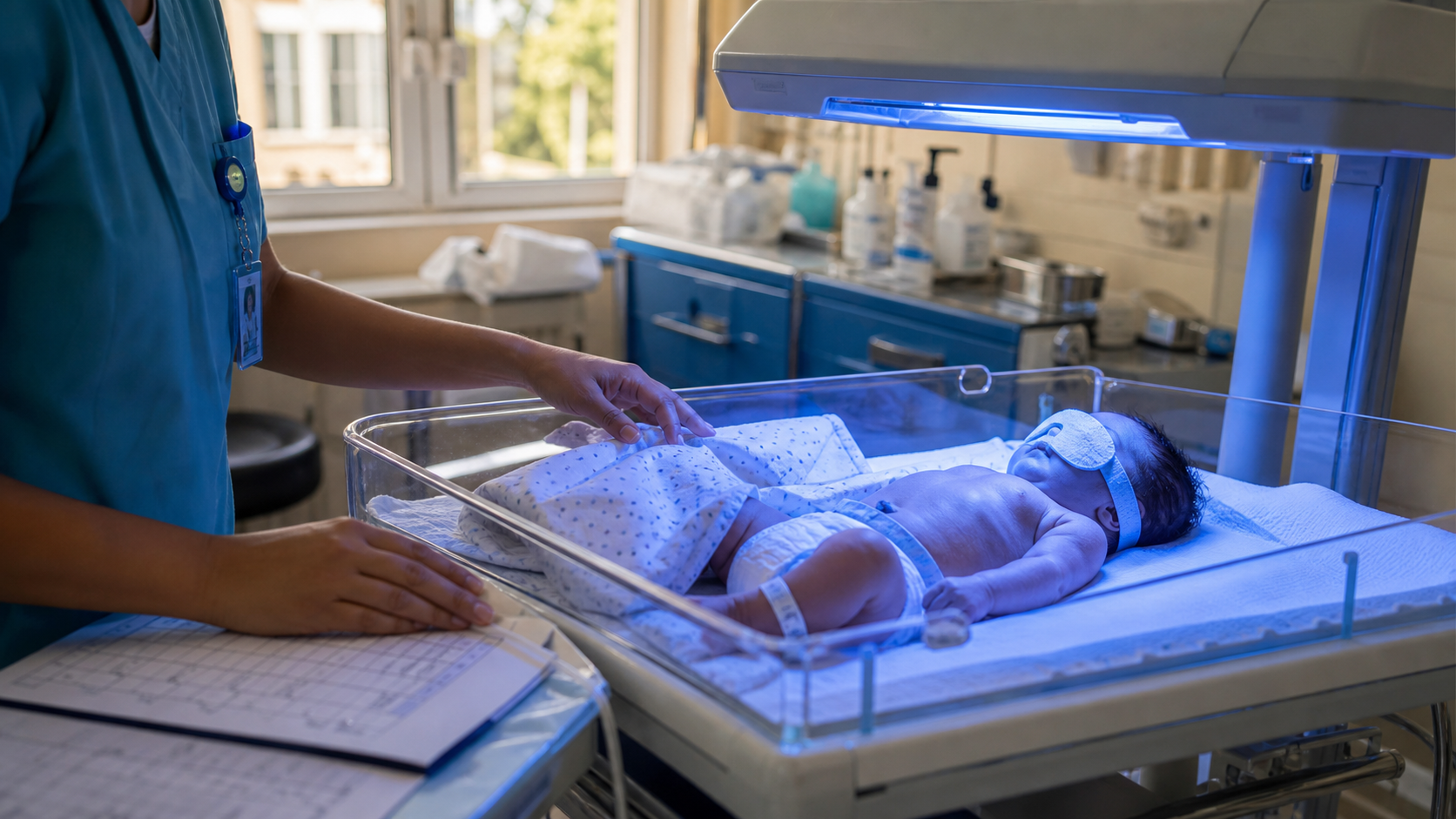
Newborn jaundice is very common. Many babies become yellow in the first week of life, and most cases are mild. But some babies develop bilirubin levels high enough to damage the brain if treatment is delayed.
So the right approach is not panic. It is timely checking.
The first question I care about is not only “how yellow is the baby?” It is also: how many hours old is the baby, is the baby feeding, is the baby premature, and is the yellow color moving to the palms and soles?
Why Do Newborns Become Yellow?
Jaundice happens when bilirubin builds up in the blood. Newborns make bilirubin as old red blood cells break down, and their liver may take a few days to process it efficiently.
That is why mild jaundice after the first 24 hours can be normal. But jaundice in the first day of life is more concerning and should be checked urgently.
When Jaundice Is More Risky
- Jaundice appears within the first 24 hours
- Baby is premature or low birth weight
- Baby is not feeding well
- Baby is very sleepy, floppy or difficult to wake
- Yellow color is reaching palms or soles
- Dark urine or pale stool
- Blood group incompatibility is suspected
- Previous sibling needed phototherapy or exchange transfusion
Sunlight Is Not a Safe Treatment Plan
Many families are told to keep the baby in sunlight. This should not replace medical assessment. Sunlight exposure can cause overheating, dehydration and inconsistent bilirubin reduction. If bilirubin is high, the baby needs proper phototherapy under medical supervision.
What Is Phototherapy?
Phototherapy is blue light treatment that helps break down bilirubin so the baby can remove it from the body. It is common, safe when done properly, and much better than waiting until jaundice becomes dangerous.
Feeding Matters
Poor feeding can worsen jaundice. A newborn should feed frequently and pass urine/stool regularly. If breastfeeding is not going well, the solution is not blame. The mother and baby need help with latch, feeding frequency, and follow-up.
When to Go to Hospital Immediately
- Baby is yellow on day 1
- Baby is not feeding
- Baby is excessively sleepy or has abnormal movements
- Baby has fever or low temperature
- Baby has fast breathing or looks sick
- Jaundice is increasing rapidly
Newborn jaundice is common, but the dangerous cases are dangerous because families wait too long. If you are unsure, get the baby checked. A simple bilirubin test can prevent a lifetime of harm.
A Simple Day-Wise Way to Think
- Yellow on day 1: urgent evaluation.
- Yellow after day 2-3: common, but still depends on level, age in hours, birth weight and risk factors.
- Jaundice lasting beyond 2 weeks: needs assessment, especially if stool is pale or urine is dark.
How Doctors Decide Treatment
The bilirubin number is interpreted with the baby’s age in hours, gestational age, weight, feeding, blood group risk, illness and other risk factors. The same bilirubin value may be okay for one baby and dangerous for another.
Common Myths
- “All jaundice is normal.” False. Many cases are mild, but some are dangerous.
- “Sunlight is enough.” Not if bilirubin is high.
- “Stop breastfeeding.” Usually not. Feeding support is often needed. Stop only if a doctor specifically advises.
- “If the eyes are yellow, wait a few days.” Do not wait if the baby is very young, sick, sleepy or feeding poorly.
Physiological vs Pathological Jaundice
Physiological jaundice usually appears after the first 24 hours, peaks over the next few days, and improves as feeding and liver processing improve. Pathological jaundice appears too early, rises too fast, lasts too long, or comes with other warning signs.
The problem is that parents cannot reliably tell the difference by eye. Even doctors do not rely only on visual inspection when jaundice looks significant. The bilirubin level and the baby’s age in hours matter.
Common Causes Doctors Think About
- Normal newborn physiological jaundice
- Breastfeeding jaundice from poor intake/dehydration
- Blood group incompatibility such as ABO or Rh problems
- Prematurity
- Bruising or cephalhematoma after delivery
- G6PD deficiency in some settings
- Infection
- Liver or bile duct problems if jaundice is prolonged with pale stool/dark urine
Why Age in Hours Matters
A bilirubin level that is acceptable on day 5 may be concerning on day 1 or 2. This is why doctors ask the exact age of the baby in hours, not only “3 days old.” Treatment thresholds change with time and risk factors.
After Discharge: What Parents Should Watch
- Is the baby feeding at least 8-12 times per day if breastfeeding?
- Is urine output adequate?
- Is stool changing from dark meconium to yellowish stool?
- Is yellow color increasing toward abdomen, legs, palms or soles?
- Is the baby becoming sleepy, floppy, high-pitched crying or difficult to wake?
Prolonged Jaundice
If jaundice persists beyond two weeks, especially with pale stool or dark urine, it needs assessment. Biliary atresia and other cholestatic diseases are uncommon but time-sensitive. Do not keep waiting with only sunlight or home remedies.

Jaundice Facts Table
| Finding | Meaning | Action |
|---|---|---|
| Yellow on first day | More likely pathological. | Urgent bilirubin check. |
| Poor feeding + jaundice | Risk of dehydration and rising bilirubin. | Feeding support and medical review. |
| Pale stool/dark urine | Possible cholestasis/biliary disease. | Do not wait; needs evaluation. |
| Sleepy/floppy/high-pitched cry | Possible bilirubin neurotoxicity or serious illness. | Emergency care. |
Recent Advances and Availability
In Nepal, bilirubin testing and phototherapy are available in many hospitals, but access, early discharge, home births, transport and delayed follow-up remain problems. Developed settings use universal risk assessment, transcutaneous bilirubin screening, hour-specific nomograms, LED phototherapy and strong post-discharge follow-up systems. The technology matters, but the most important step for families is still early checking when jaundice is significant.
Nepal Parent Message
Sunlight is not a reliable treatment plan for significant newborn jaundice. It can delay proper phototherapy and can expose the baby to overheating or dehydration.
Sources and Useful Links
Sources and Further Reading
Exchange Transfusion: Rare but Serious
Most babies with jaundice who need treatment receive phototherapy. A small number with very high or dangerous bilirubin may need exchange transfusion. This is a serious procedure where the baby’s blood is gradually replaced to reduce bilirubin and antibodies. The goal is to prevent bilirubin brain injury.
The point for parents is simple: do not let jaundice reach that stage by waiting too long. Early bilirubin checking and timely phototherapy can prevent many severe cases.
Treatment Availability and Recent Advances
| Tool/treatment | Nepal reality | Developed setting |
|---|---|---|
| Serum bilirubin | Available in hospitals; access may be delayed by geography/cost. | Often combined with transcutaneous screening and risk nomograms. |
| Phototherapy | Available in many hospitals; quality and device type vary. | LED intensive phototherapy, irradiance checks, clear protocols. |
| Exchange transfusion | Available only in higher centers and used for severe cases. | Rare due to earlier detection and phototherapy. |
| Follow-up after discharge | Often weak, especially after early discharge or home birth. | Structured postnatal follow-up based on bilirubin risk. |
Why Some Babies Are Higher Risk
- Prematurity
- Low birth weight
- Blood group incompatibility
- Previous sibling needing phototherapy
- Poor feeding or dehydration
- Bruising/cephalhematoma
- G6PD deficiency risk
- Sepsis or illness
What Parents Should Ask Before Going Home
If the baby looks yellow before discharge, ask: what is the bilirubin level, what is the baby’s age in hours, is follow-up needed tomorrow, and what warning signs mean immediate return? A discharge without a follow-up plan is risky when jaundice is visible.
Phototherapy: What Parents See in the NICU
During phototherapy, the baby is placed under special blue light with eye protection. More skin exposure helps treatment work, so the baby may be kept in minimal clothing. Feeding should continue unless the baby is too sick. Doctors and nurses monitor temperature, hydration, bilirubin trend and whether treatment can be stopped.
Phototherapy is not painful. The stress for parents is seeing the baby under lights, but the treatment itself is meant to prevent a much worse outcome: bilirubin brain injury.
Why Follow-Up After Discharge Matters
Some babies become more yellow after going home, especially if discharged early. Parents should not rely only on visual judgment in poor lighting. If jaundice is increasing, feeding is poor, or the baby is sleepy, bilirubin should be checked. Early follow-up is especially important for preterm and low-birth-weight babies.
What Makes Newborn Jaundice Dangerous
Bilirubin becomes dangerous when levels rise high enough to cross into the brain. This can cause acute bilirubin encephalopathy and, in severe cases, kernicterus, a permanent form of brain injury. This is why doctors take early jaundice, rapidly increasing jaundice, poor feeding and abnormal behavior seriously.
The tragedy is that severe bilirubin injury is often preventable. The tools are not exotic: feeding support, bilirubin measurement, phototherapy, and exchange transfusion for the rare severe case. The problem is delay.
Practical Nepal Follow-Up Advice
If a baby is discharged early, lives far from hospital, is premature, is not feeding well, or already looked yellow in hospital, the family should know exactly when to return. “Come if yellow increases” is vague. A better instruction is: return tomorrow for bilirubin check, or return immediately if baby feeds poorly, becomes sleepy, urine decreases, fever appears, or yellow reaches palms/soles.
One practical rule: visible jaundice plus poor feeding is enough reason to recheck early, especially in the first week of life.
No spam. Just a short email when I publish something new.