
Updated: May 2026
This is a Nepal-focused outbreak note from a pediatrics resident. It is written for parents, medical students, health workers, and anyone trying to understand why diseases we can prevent with vaccines still return.
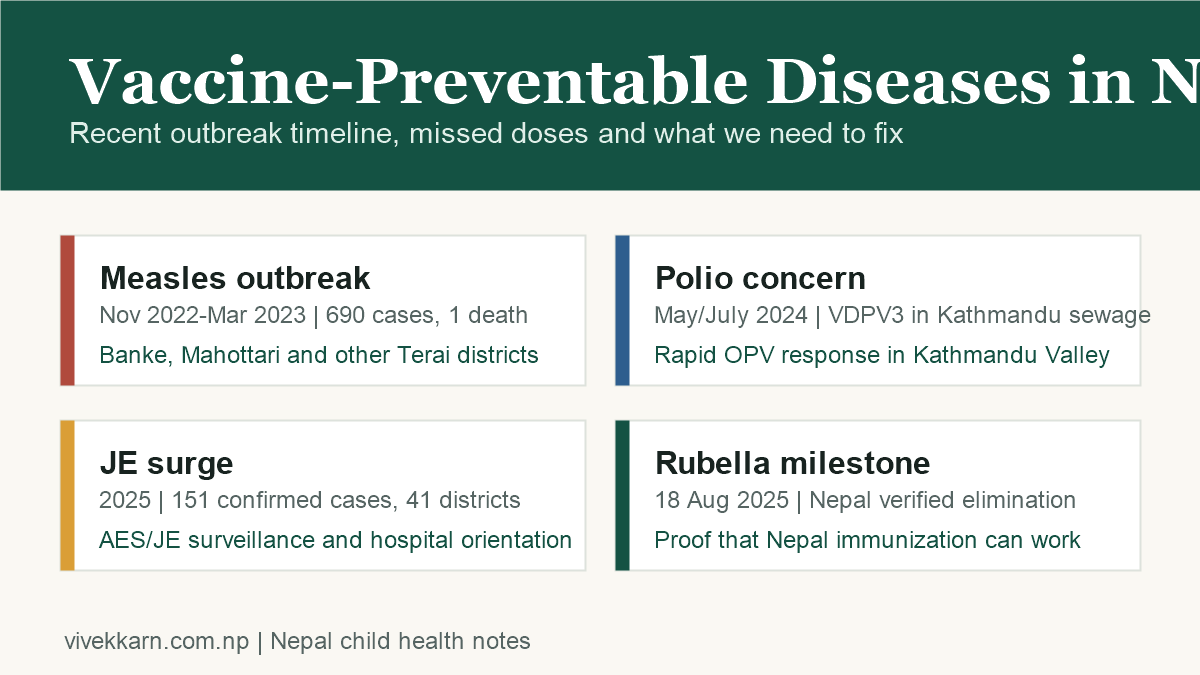
Short answer: vaccine-preventable diseases in Nepal are not only textbook history. From the 2023 measles outbreak to the 2024 polio sewage detection and the 2025 Japanese encephalitis surge, the message is the same: when routine immunization misses children, outbreaks find them.
Why I am writing this
In pediatrics, vaccines are not an abstract public health topic. They become real when a child comes with pneumonia after measles, when a child with encephalitis is seizing, or when a parent says, ?Doctor, we missed one vaccine but thought it would not matter.?
Nepal has achieved a lot through the Nepal EPI program. We have routine immunization, campaigns, cold chain systems, health posts, female community health volunteers, surveillance medical officers, and outbreak response teams. These systems have saved thousands of children.
But outbreaks do not care about national averages. If one pocket of children is missed, that pocket can become the starting point.
Recent Outbreaks of Vaccine-Preventable Diseases in Nepal
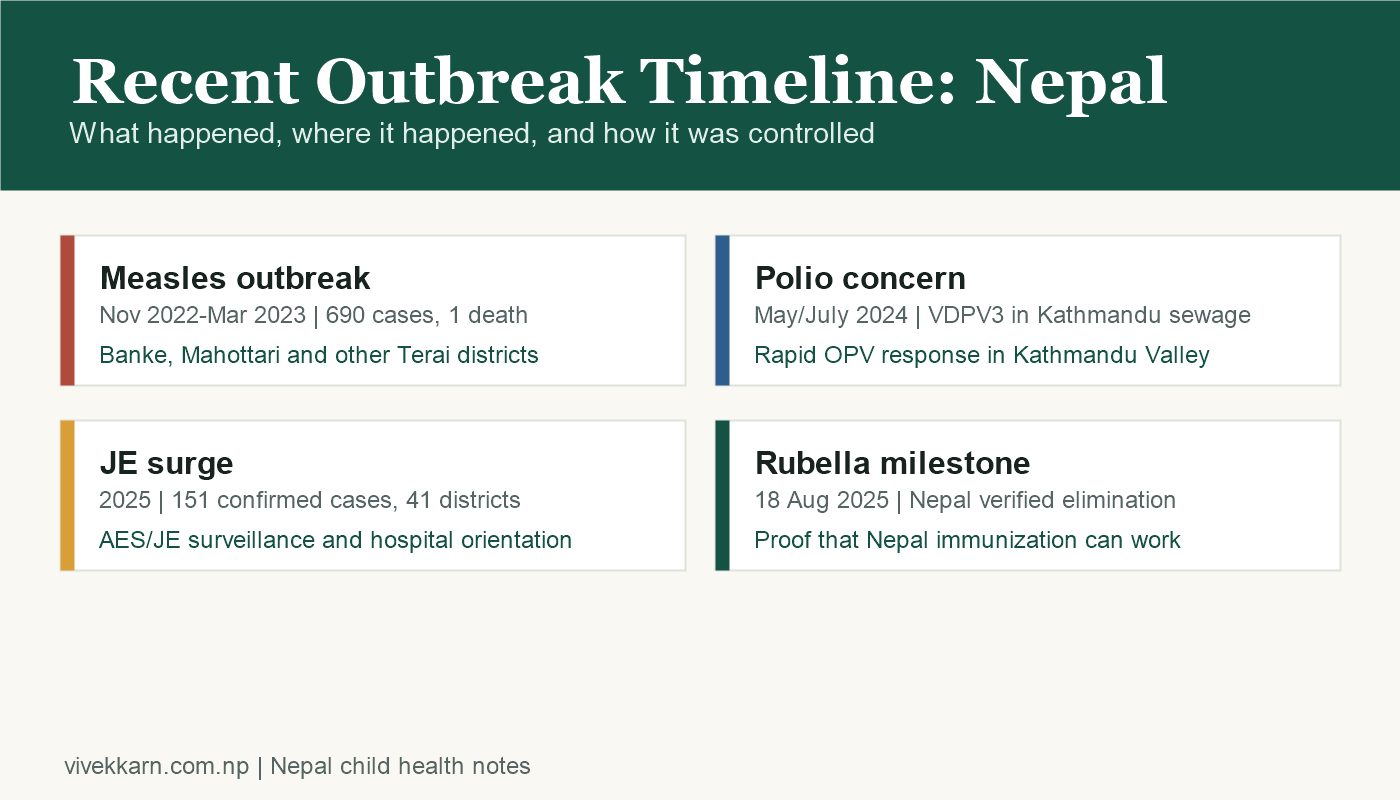
Here is the cleaner outbreak picture, with dates, places, and response measures.
| Disease/event | When | Where | What happened | How it was controlled |
|---|---|---|---|---|
| Measles outbreak | Index illness began 24 Nov 2022; outbreak confirmed 2 Jan 2023; cases reported up to 10 Mar 2023 | Started in Nepalgunj, Banke; spread across western and eastern Terai districts | 690 cases and 1 death reported by WHO; most cases were children under 15 | Active case search, case management, outbreak response immunization, contact tracing, community engagement, and later the 2024 MR campaign |
| Polio concern | Sewage sample collected 26 May 2024; public reporting and response in July 2024 | Kathmandu Valley, including sewage from the Tukucha-Bagmati area | Vaccine-derived poliovirus type 3 detected in sewage; no paralytic polio outbreak reported | Rapid risk assessment, surveillance strengthening, field monitors, and targeted bOPV campaign reaching more than 300,000 under-five children |
| Japanese encephalitis surge | 2025, during JE season | 151 laboratory-confirmed cases across 41 districts in all 7 provinces | Severe AES/JE burden with case fatality close to 20% in WHO Nepal reporting | AES/JE surveillance manual, clinical protocol, diagnostic kits, case investigation, health worker orientation, and public awareness |
| Rubella elimination | 18 Aug 2025 | National milestone | WHO verified Nepal had eliminated rubella as a public health problem | Years of MR vaccination, surveillance, laboratory work, campaigns, and routine immunization strengthening |
1. Measles outbreak Nepal: the warning we should not forget
The major measles outbreak Nepal faced in 2023 was confirmed on 2 January 2023 in Nepalgunj Sub-Metropolitan City, Banke, after clusters of fever and rash were reported. WHO later identified the index case as having symptom onset on 24 November 2022.
Between 24 November 2022 and 10 March 2023, WHO reported 690 measles cases and one death. The cases were not limited to one place. They were reported from:
- Banke: 327 cases
- Surkhet: 62 cases
- Bardiya: 49 cases
- Kailali: 39 cases
- Kanchanpur: 27 cases
- Bajura: 13 cases
- Dang: 12 cases
- Mahottari: 103 cases
- Sunsari: 34 cases
- Morang: 24 cases
Most of these were Terai districts. Many affected children were either unvaccinated or incompletely vaccinated. WHO also noted that the outbreak happened in a population with suboptimal immunity, partly linked to disruption of routine immunization during the COVID-19 pandemic.
Clinically, measles is not just fever and rash. It can cause pneumonia, diarrhea, otitis media, malnutrition worsening, encephalitis, and death. In the pediatric ward, measles becomes dangerous when it reaches children who are undernourished, too young, unvaccinated, or already sick.
How the measles outbreak was controlled
The response included active case search, case management, surveillance, contact tracing, and outbreak response immunization. WHO teams supported field monitoring and coordination with the Ministry of Health and Population. Community and religious leaders were also engaged because outbreak control is not only a medical activity; it needs trust.
The bigger control measure came through the 2024 nationwide measles-rubella vaccination campaign, launched on 25 February 2024. Nepal aimed to vaccinate about 5.7 million children. In 24 high-risk districts, children from 9 months to under 15 years were targeted. In other districts, the focus was 9 months to under 5 years. The campaign also provided missed routine vaccines such as pentavalent, pneumococcal, and IPV to eligible children.
2. Cross-border measles risk from India
Banke borders India, and many Terai districts have frequent cross-border movement. Families cross for work, school, treatment, trade, marriage, and daily life. This is normal for border communities.
But measles uses movement very efficiently. A child infected on one side of the border may travel before the rash appears. If the next community has under-vaccinated children, the virus spreads quickly.
This is not about blaming India or Nepal. It is how infectious diseases behave. The practical answer is better fever-rash surveillance, high MR coverage in border municipalities, and fast sharing of outbreak information across the border.
3. Japanese encephalitis: not a single outbreak, but a serious 2025 surge
Japanese encephalitis is different from measles. It does not usually spread child-to-child in the same way. It is mosquito-borne, linked to Culex mosquitoes, pigs, birds, water bodies, and seasonal ecology. But it is still a vaccine-preventable disease, and in children it can be devastating.
WHO Nepal’s 2024-2025 biennium report described a significant JE challenge in 2025: 151 laboratory-confirmed cases across 41 districts in all seven provinces, with a case fatality ratio of nearly 20%.
That number is not small. JE can present as acute encephalitis syndrome: fever, altered sensorium, seizures, abnormal movements, neck stiffness, coma, or focal neurological signs. Some children survive with long-term neurological disability. Some do not survive.
How the JE response was strengthened
The response was more about surveillance, early recognition, and clinical readiness than a one-day campaign. WHO supported the development and dissemination of an Acute Encephalitis Syndrome/Japanese Encephalitis surveillance manual and a clinical case management protocol.
According to WHO Nepal, around 3,500 medical health professionals from 51 hospitals were oriented on the updated protocol. Rapid response teams received orientation. District teams investigated cases. Diagnostic test kits were supplied to JE laboratories. Public awareness activities were also pushed during peak JE season.
For clinicians, the lesson is simple: during JE season, acute encephalitis in a child should not be managed casually. Think early, stabilize early, refer early, and check immunization history.
4. Polio concern in Kathmandu: sewage detection before paralysis
Polio is the disease Nepal has fought very hard to keep away. Nepal has been polio-free for years, but in 2024, surveillance found a warning signal.
The Kathmandu Post reported that vaccine-derived poliovirus type 3 was detected in sewage samples collected from the Tukucha and Bagmati River confluence in Kathmandu. The sample was collected on 26 May 2024, and the issue was publicly reported in July 2024.
This was not a clinical outbreak of paralytic polio. But it was still serious. Environmental surveillance is meant to catch poliovirus before children start presenting with paralysis.
How the polio risk was controlled
WHO’s Nepal results report describes the response as rapid. After VDPV3 was detected in sewage in July 2024, the Ministry of Health and Population, WHO, and partners coordinated risk assessment, strengthened surveillance, mobilized field monitors, and launched a targeted vaccination campaign.
The response reached more than 300,000 children under five in high-risk districts. In practical terms, this is exactly what should happen: detect the virus early, vaccinate quickly, and prevent paralysis before it appears.
For parents, the point is clear. Do not skip polio vaccine because polio looks rare. Polio looks rare because vaccination and surveillance have been working.
5. Rubella elimination in August 2025: the positive contrast
There is also good news. On 18 August 2025, WHO verified that Nepal had eliminated rubella as a public health problem.
This is a real achievement. Rubella elimination did not happen because of one announcement. It happened because of routine immunization, MR campaigns, surveillance, laboratory confirmation, and years of field work.
It is also an important contrast. Nepal can eliminate vaccine-preventable disease when coverage, surveillance, and public trust come together. Rubella elimination should make us more ambitious for measles elimination, not more relaxed.
The immunization gap: why outbreaks still happen
The uncomfortable truth is that coverage gaps remain. If a vaccine dose reaches around 89% of children, that still means roughly 11% miss that dose. For highly contagious diseases like measles, that is enough to create risk.
And the full schedule gap is even larger. The Nepal Demographic and Health Survey 2022 showed that about 80% of children aged 12-23 months were fully vaccinated with basic antigens, while only about 52% were fully vaccinated according to the national schedule.
Missed children are not evenly spread. They cluster in places like urban slums, mobile families, brick kiln communities, border areas, remote settlements, and households where the card is lost or the mother never got a clear explanation.
This is how a vaccine-preventable disease outbreak 2024 or 2025 begins. Not because vaccines failed, but because enough children were missed in the same place.
COVID-19 and the delayed effect on outbreaks
COVID-19 affected routine immunization in Nepal in several ways. Outreach sessions were disrupted. Families avoided health facilities. Transport was difficult. Health workers were diverted. Some parents delayed vaccines and never returned for catch-up.
WHO specifically linked the 2023 measles outbreak context to suboptimal immunity, partly due to routine immunization disruption during the COVID-19 pandemic.
This is why we still have to ask about missed doses years later. A child who missed a vaccine during COVID may remain susceptible long after lockdowns are forgotten.
What parents should do now
- Check the vaccine card. Do not rely only on memory.
- If a dose was missed, ask for catch-up vaccination. Many missed vaccines can still be given later.
- Do not delay vaccination for mild cough, cold, or minor illness without asking a health worker.
- Keep the card safe. It matters for catch-up, school, travel, and future medical decisions.
- Ask questions, but ask reliable people. A trained health worker or pediatrician is better than a random social media post.
What health workers and local governments should do
Every OPD visit is a chance to check vaccination status. Fever visit, diarrhea visit, nutrition visit, newborn follow-up, school health visit: all of these are chances to ask whether the vaccine card is complete.
For local governments, missed-dose tracking should be treated as outbreak prevention. A child who has missed MR, polio, JE, pentavalent, or other routine vaccines is not just an incomplete record. That child may be part of the next outbreak chain.
Schools can help by reminding parents. Municipalities can map missed children. Health posts can follow up defaulters. Pediatricians can normalize vaccine-card checking in every visit.
My take as a pediatric resident
Vaccination awareness should not sound like scolding. Most parents who miss vaccines are not careless. Some migrate. Some lose the card. Some are confused. Some were told to wait. Some could not reach the session. Some simply did not understand the risk.
Our job is to close that gap without humiliating them.
Measles, polio, Japanese encephalitis, and rubella all teach us the same lesson: vaccines protect individual children, but they also protect communities. Nepal has already shown what is possible with rubella elimination. Now we need to find the missed children before the next outbreak finds them first.
Sources checked
- WHO Disease Outbreak News: Measles – Nepal, 14 March 2023
- WHO Nepal: Responding to Measles Outbreak, 11 January 2023
- WHO Nepal: Measles-Rubella Vaccination Campaign Launched in Nepal, 25 February 2024
- WHO South-East Asia: Nepal Eliminates Rubella, 18 August 2025
- WHO Results Report: Nepal response to vaccine-derived poliovirus
- WHO Nepal Biennium Report 2024-2025
- Kathmandu Post: Highly contagious poliovirus found in Kathmandu sewage, 19 July 2024
- Kathmandu Post: NDHS 2022 immunization gaps
No spam. Just a short email when I publish something new.