Updated: May 2026
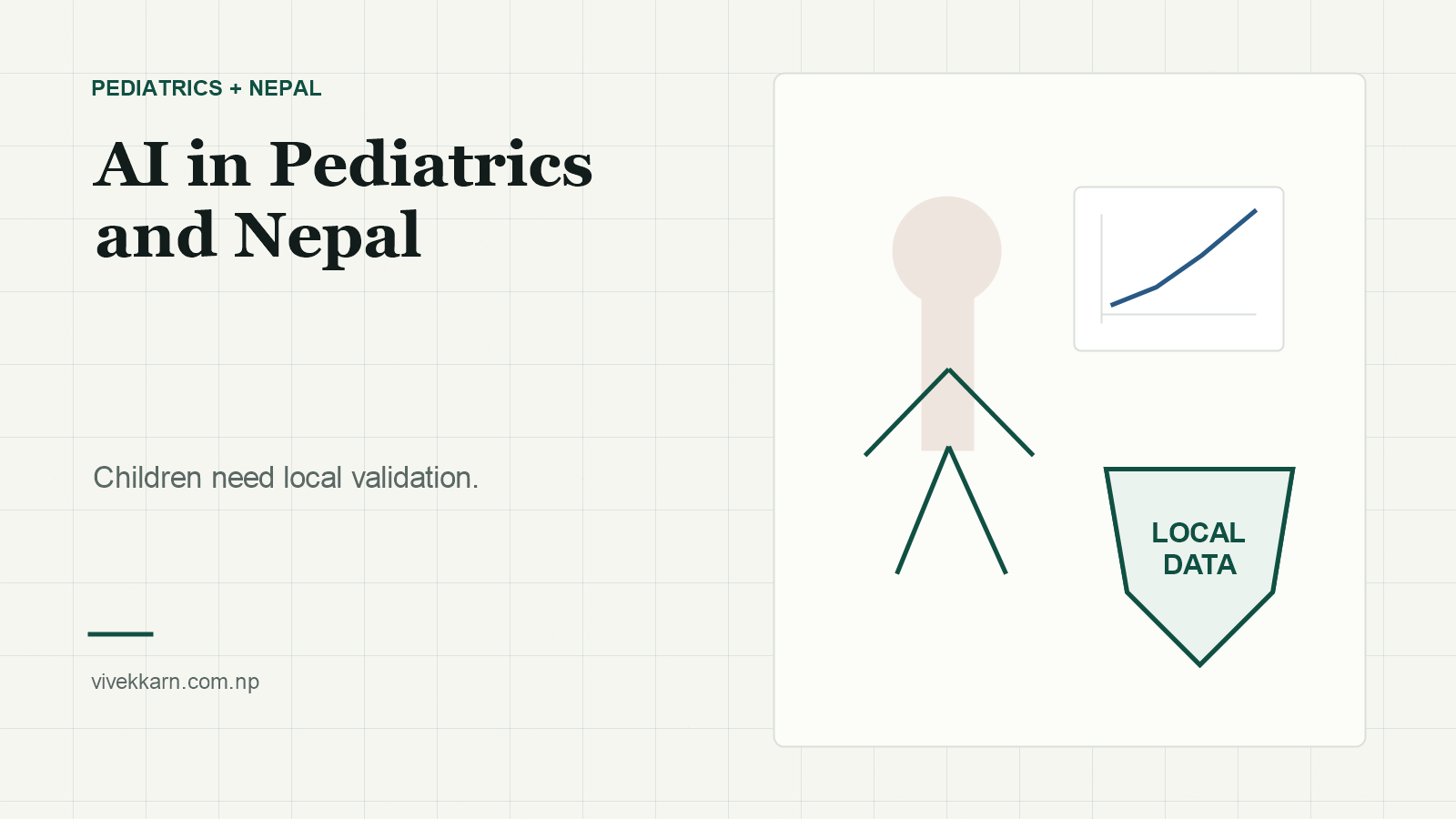
AI in pediatrics should be held to a higher standard because children are not small adults, and Nepali children are not just data points from hospitals in another country.
Short answer: AI can help pediatrics in Nepal with triage, documentation, education, dosing checks, growth monitoring, referral support, and parent counselling. But pediatric AI must be locally validated, privacy-safe, age-aware, and always supervised by clinicians.
Why pediatrics is different
Children change with age. A normal respiratory rate in a newborn is not normal in a 10-year-old. Drug doses depend on weight. Dehydration signs differ by age. Developmental history matters. Parent anxiety affects history. A child may not describe pain clearly.
This is why an AI model that performs well in adult internal medicine cannot automatically be trusted in pediatrics.
Where AI could help Nepali pediatrics
| Use case | Why it may help | Main risk |
|---|---|---|
| Drug-dose checking | Can reduce arithmetic errors | Wrong weight, wrong concentration, renal/hepatic issues |
| Growth chart interpretation | Can flag wasting, stunting, obesity, growth faltering | Poor measurements create poor output |
| OPD triage | Can remind health workers of danger signs | Cannot replace clinical examination |
| Parent counselling | Can create simple Nepali/English explanations | May over-reassure if red flags are missed |
| Resident education | Can generate cases, checklists, viva practice | Can teach wrong facts if unverified |
| Documentation | Can reduce clerical burden | Privacy, wrong notes, invented negatives |
What I would not trust AI to do alone
- Decide whether a neonate can go home.
- Rule out sepsis, meningitis, shock, or pneumonia without examination.
- Prescribe pediatric drug doses without human verification.
- Interpret danger signs from a parent message alone.
- Manage a sick child in a low-resource setting without escalation.
- Decide safeguarding, abuse, or neglect concerns without clinician review.
Nepal-specific problems AI may miss
AI tools built elsewhere may not understand local disease patterns: dengue, typhoid, scrub typhus, tuberculosis, malnutrition, neonatal sepsis, rheumatic heart disease, pesticide poisoning, snakebite, and delayed presentation after partial treatment.
Language is another issue. Parents may describe symptoms in Nepali, Maithili, Bhojpuri, Newari, Tharu, Hindi, or mixed English. A chatbot can misunderstand local phrasing and still answer confidently.
Pediatric dosing is a high-risk area
This is where AI can help and harm. A calculator can reduce arithmetic mistakes, but only if weight, unit, concentration, maximum dose, route, renal function, and indication are correct.
An AI answer saying “give amoxicillin 500 mg” is meaningless without age, weight, formulation, diagnosis, local guideline, allergy history, and severity. Pediatric dosing needs verification.
The standard hospitals should demand
- Was the model tested in children?
- Was it tested in South Asian or Nepali patients?
- Does performance differ by age group?
- Does it work in Nepali/local-language histories?
- Does it report uncertainty?
- Is patient data stored or used for training?
- Is there a process to audit errors?
- Who is responsible when the AI output harms a child?
What medical students and residents can do now
Use AI for learning, but verify with standard sources. Ask it to make tables, explain mechanisms, create cases, build checklists, or test your differential diagnosis. Do not copy its medical facts into patient care without checking.
A useful habit is to ask: “What would make this answer wrong?” or “What red flags should change the plan?”
My take
AI in pediatrics should be boringly safe before it becomes exciting. The goal is not to replace pediatricians. The goal is to reduce missed danger signs, improve documentation, support health workers, and help families understand care better.
For Nepal, the best AI tools will be the ones designed around our clinical reality, not imported as glossy software without local proof.
Sources checked
- WHO: Ethics and governance of AI for health – large multimodal models
- Stanford HAI: 2026 AI Index, Medicine chapter
- Nature Medicine: Generative artificial intelligence in medicine
- FDA: AI in software as a medical device
No spam. Just a short email when I publish something new.