
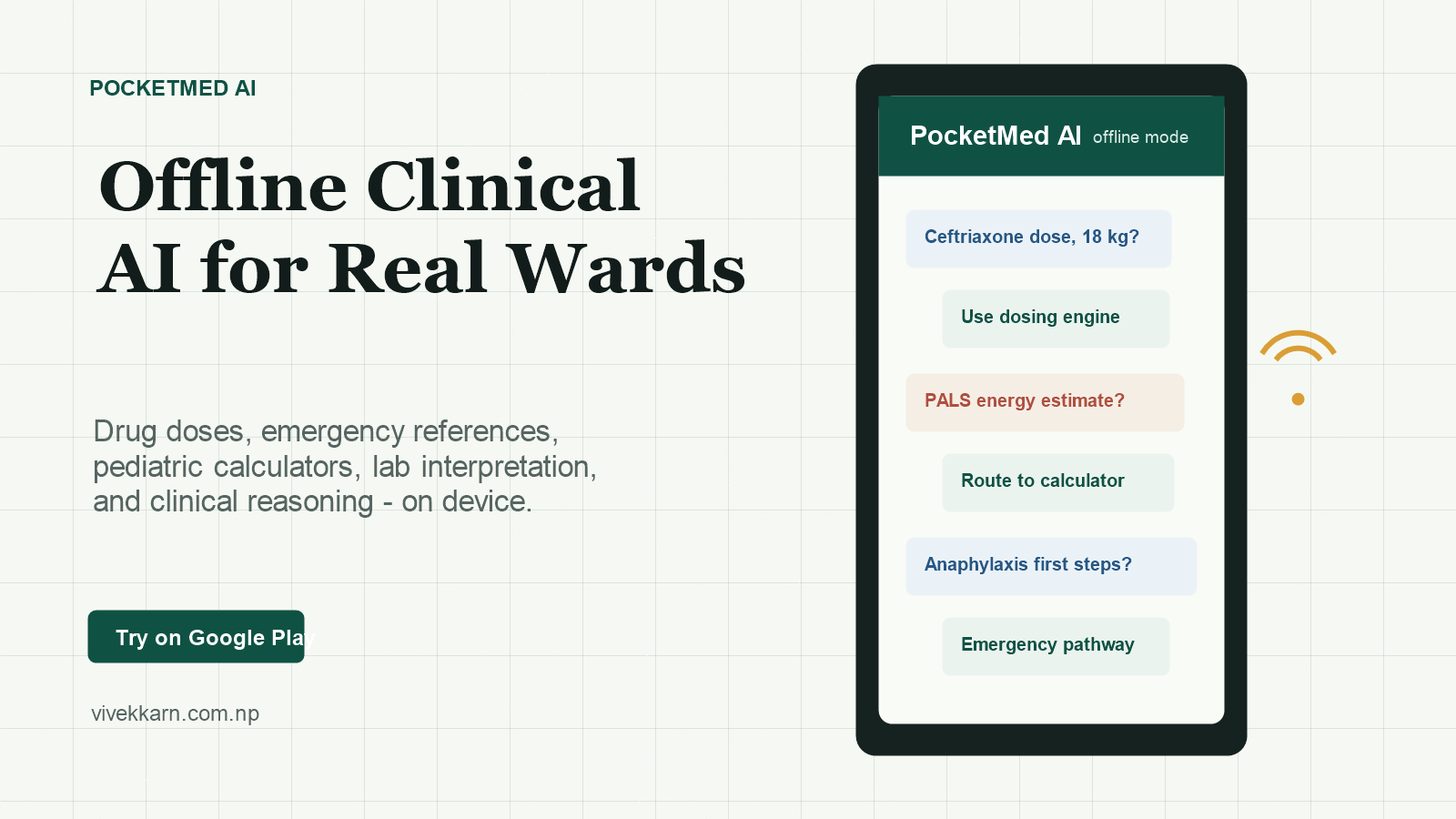
PocketMed AI is an offline-first clinical assistant I built while living the exact problem it tries to solve: clinical work where the question is urgent, the internet is unreliable, and the answer still has to be checked carefully.
I built PocketMed AI as a pediatrics resident in Nepal, shaped by ward duty, emergency calls, night shifts, and the ordinary reality of hospital work here. This was not a polished idea from a conference slide. It came from the kind of moments where you need a dose, a formula, a differential, or an emergency step quickly, but you also know that blindly trusting any tool would be unsafe.
Updated: May 2026
I built PocketMed AI because most medical tools assume a perfect world: fast internet, enough time, clean documentation, clear protocols, and a clinician sitting peacefully at a desk. That is not where most clinical decisions happen.
Short answer: PocketMed AI is an offline medical AI app for doctors, residents, interns and medical students. It is built for bedside clinical reasoning, pediatric drug dosing, emergency references, calculators, scoring systems, lab interpretation and formula explanations, without needing constant internet access.
Install PocketMed AI on Google Play
The Problem I Wanted to Solve
During clinical work, the question is rarely elegant.
It is usually something like:
- What is the ceftriaxone dose for this weight?
- How much fluid should I start?
- What are the red flags in croup?
- What is the PALS shock energy?
- How do I calculate anion gap or delta ratio again?
- What should I not miss in a child with severe asthma?
These are not research questions. They are bedside questions. They come during rounds, ER shifts, night duty, rural postings, and moments where the internet may or may not work.
That is why I did not want PocketMed AI to be just another cloud chatbot. The app had to work closer to the clinician, on the device, with clinical tools built around real workflow.
What PocketMed AI Is
PocketMed AI is a clinical reference and AI assistant built for real-world medicine. The Google Play listing describes it as made for doctors, residents and medical students working in low-resource and offline environments. That is exactly the audience I had in mind.
It is not meant to replace a senior, a guideline, a pharmacist, or clinical judgment. It is meant to help you reach the right structure faster.
| Instead of… | PocketMed AI tries to… |
|---|---|
| Searching five apps during duty | Bring common clinical tools into one offline workspace |
| Letting AI guess doses | Route dose questions to local dosage logic where supported |
| Reading long references in emergencies | Surface structured red flags and first steps |
| Depending on internet | Keep core workflows available on-device |
| Sending sensitive questions to random cloud tools | Use an offline-first, privacy-conscious design |
The Use Case Is Very Specific
The strongest use case is not casual medical curiosity. It is the resident or medical officer who is already thinking clinically and needs support with structure.
For example: a child comes in sick, the team is preparing fluids and drugs, and you want a quick weight-based estimate. Or you are revising an acid-base problem after an ABG. Or you need to organize a differential before calling a senior. PocketMed AI is meant to help with that first layer of thinking, not to replace the clinician responsible for the child.
Why Offline Matters
Offline is not a small feature. For me, it is the point.
Hospitals do not always have reliable Wi-Fi. Mobile data can fail inside wards. Rural health posts may not have stable connectivity. Emergency decisions do not wait for a server to respond.
PocketMed AI is designed so many practical clinical workflows can run without constant internet dependency. The Play Store listing states that the app requires no internet after install, no login, and no subscription wall. It also lists no data collected and no data shared with third parties in its Data safety section.
That matters because clinical questions can be sensitive. Even when a name is not typed, a clinical prompt can contain enough context to deserve caution.
Clinical Skill Routing: The Part I Care About Most
The most important design idea is this: not every question should go to the same AI brain.
A dose question is different from a formula question. A resuscitation estimate is different from a general explanation. An emergency pathway is different from a casual teaching answer.
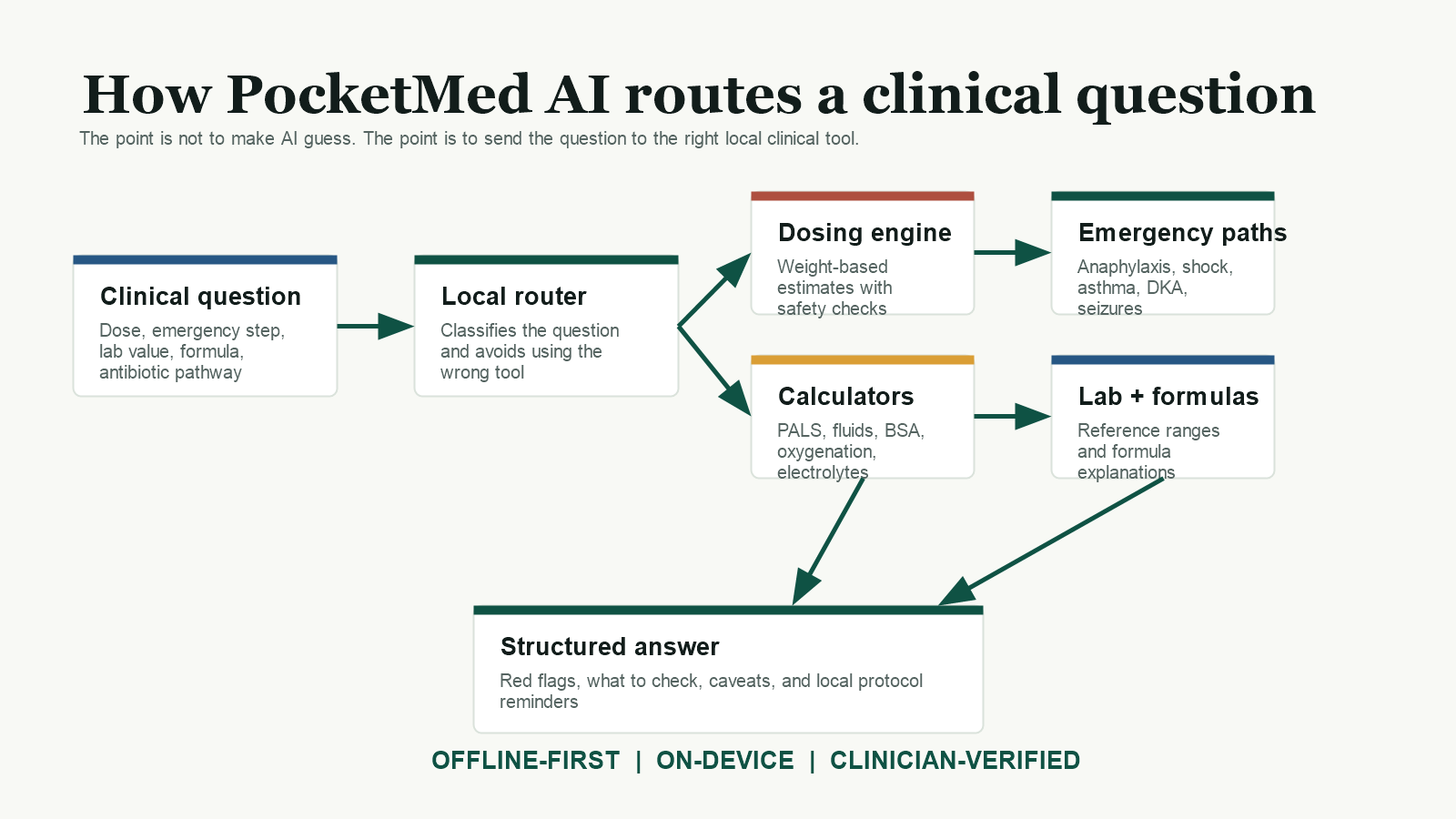
That is why PocketMed AI uses clinical skill routing. The app tries to understand the type of question and send it to the right local tool when possible.
| Question type | Better local skill | Reason |
|---|---|---|
| “Ceftriaxone dose for 18 kg?” | Drug dosing engine | Pediatric doses should be calculated, not hallucinated |
| “PALS shock energy for 12 kg?” | Resuscitation calculator | Emergency numbers need deterministic logic |
| “Explain delta ratio.” | Formula reference | Learners need variables, use and interpretation |
| “Anaphylaxis first steps?” | Emergency quick reference | Urgent care needs a structured sequence |
| “Pneumonia antibiotic options?” | Antibiotic pathway support | Depends on age, severity, allergy, resistance and protocol |
What You Can Use It For
1. Pediatric Drug Dosing
PocketMed AI can support weight-based pediatric dosing for common medicines where data are bundled. This is useful for quick checks during duty, especially when the question is practical and time-sensitive.
It should still be verified against local protocol, pharmacy advice, formulation, maximum dose, renal/hepatic function and patient-specific factors.
2. Emergency References
The app can help with quick references for scenarios such as anaphylaxis, septic shock, severe asthma, croup, bronchiolitis, DKA, status epilepticus, hypoglycemia, poisoning and severe dehydration.
The goal is not long textbook reading. The goal is a structured reminder: what to do first, what to monitor, when to escalate and what to avoid.
3. Pediatric Calculators
Useful bedside calculations include maintenance fluids, fluid bolus, PALS emergency drug estimates, defibrillation/cardioversion energy, ET tube size, BMI, BSA, eGFR, oxygenation index, tidal volume, sodium correction, potassium replacement guidance and burn fluid estimates.
4. Scores and Criteria
PocketMed AI supports tools such as APGAR, Pediatric Glasgow Coma Scale, Westley Croup Score, Pediatric Asthma Score, BRUE low-risk criteria, Kawasaki criteria, Kocher septic hip criteria and pediatric SIRS/sepsis screen.
5. Formula and Lab Help
For students and residents, this is one of the most useful parts. The app can explain formulas like anion gap, delta ratio, Winter’s formula, oxygenation index, PaO2/FiO2 ratio, BSA, BMI and eGFR.
It can also help search local lab reference information for common values like hemoglobin, WBC, creatinine, glucose and bilirubin.
Try These Prompts
If you install the app, do not just ask vague questions. Try clinical prompts that reflect real use:
- “Ceftriaxone dose for a 14 kg child.”
- “Maintenance fluid for 18 kg.”
- “PALS defibrillation energy for 12 kg.”
- “Westley croup score: stridor at rest, moderate retractions, alert child.”
- “Explain delta ratio with interpretation.”
- “Anaphylaxis emergency steps in a child.”
- “What should I check before prescribing amoxicillin?”
What It Is Not
PocketMed AI is not a replacement for clinical judgment. It is not a substitute for senior advice. It is not a final prescribing authority. It is not a way to bypass local hospital protocols.
Final decisions should still be checked against:
- Local hospital protocols
- Current guidelines
- Senior clinician advice
- Pharmacy recommendations
- Patient allergy history
- Renal and hepatic function
- Drug formulation and maximum dose
- Local antimicrobial resistance patterns
Why I Think This App Matters
Most AI tools are built for people with stable internet, expensive subscriptions and a workflow that assumes the clinician has time. PocketMed AI is built from the opposite direction.
It asks: what would be useful during duty, in a ward, in an ER, during a rural posting, when your senior is busy, when you need a number quickly, and when the internet is not guaranteed?
That is the gap I wanted to fill.
Safety First
Responsible medical AI should not hide uncertainty. WHO’s guidance on large multimodal models in health emphasizes governance, transparency, risk management and human oversight. FDA clinical decision support guidance also stresses that clinicians should be able to independently review the basis for recommendations.
That is how I think about PocketMed AI too. It should help organize clinical thinking, not replace it.
My Request
If you are a doctor, resident, intern or medical student, try PocketMed AI during your normal study or clinical workflow. Start with non-identifiable questions. Test the calculators. Try emergency references. Check drug doses, then verify them the way you normally should.
If something is missing, tell me. If something feels wrong, tell me faster. This app will become better only if real clinicians use it in real settings and give honest feedback.
Download PocketMed AI on Google Play
Sources and Links
- PocketMed AI: Offline Med AI on Google Play
- WHO: Ethics and governance of AI for health – large multimodal models
- FDA: Clinical Decision Support Software guidance
No spam. Just a short email when I publish something new.